Resin Driveways and Planning Permission in Newark: What Homeowners Need to Know
Planning permission is one of those topics that can put people off starting a driveway project before they've even looked at costs. For most homeowners in Newark and the surrounding area, the good news is that a resin-bound driveway is one of the few surface types that typically sidesteps the planning rules entirely, but understanding why matters, because not all resin products are equal on this front, and the way a driveway is installed affects whether it qualifies.
The Planning Rule That Applies to Front Driveways
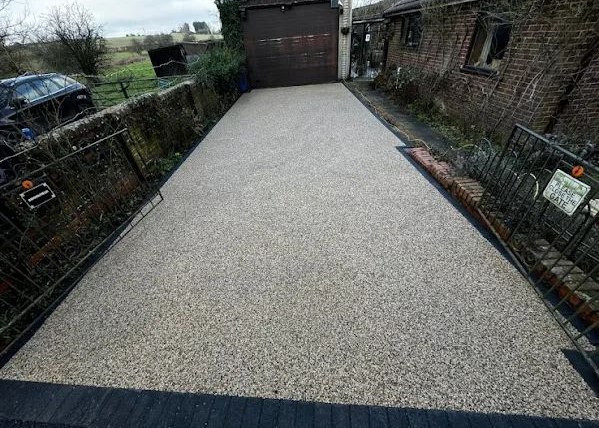
The relevant requirement kicks in when a new or replacement driveway over 5 square metres uses an impermeable surface, one that sends rainwater running off the top rather than draining through it, and that water flows towards the public highway. The rule was introduced to address surface water flooding, a growing concern in lower-lying parts of Nottinghamshire and Lincolnshire, including parts of the Newark area where the Trent Valley floor doesn't drain quickly in heavy rain. Resin Driveways Lincoln regularly installs resin-bound surfaces across the Newark area, and the permeable nature of a properly laid resin-bound driveway means planning permission isn't required in the vast majority of residential cases.
What "Permeable" Actually Means in Practice
A resin-bound surface is permeable because the resin coats the aggregate stones individually and bonds them together without filling the gaps between them. Those gaps allow rainwater to pass through the surface and into the sub-base below, rather than running off sideways across the driveway and into the road or neighbouring ground. This is different from resin-bonded surfacing, which is a related but distinct product where the resin is spread across a solid base and aggregate scattered on top — that creates a decorative, textured finish but it's not permeable, and therefore doesn't have the same planning exemption. If you're getting quotes, it's worth asking explicitly whether the product is resin-bound (permeable) or resin-bonded (not permeable), since the terms get used loosely by some installers.
What Happens If a Property Is in a Conservation Area
Newark has a town centre conservation area, and properties on the edge of it, or those that are listed buildings, may have additional restrictions that apply regardless of whether the surface itself is permeable. In these cases, even a technically compliant permeable driveway may require prior approval from Newark and Sherwood District Council if it involves changes to the character of the frontage. It's worth a quick check before work starts rather than after, particularly for properties close to the market place or within the older parts of the town.
The Drainage Benefit Beyond Planning
Even setting aside the planning question, the permeability of a resin-bound surface is genuinely useful for Newark homeowners. Parts of the Newark area, particularly properties near the River Trent, are in flood risk zones where any additional surface water runoff is a real concern rather than a theoretical one. A permeable driveway reduces the amount of water entering the road drainage system during heavy rain, which matters both for individual properties and for the wider area. A well-installed resin driveway with a suitable permeable sub-base can handle the equivalent of very heavy rainfall without puddling on the surface, something that can't be said for impermeable alternatives.
Cost and the Planning Question Together
We've covered what a resin driveway costs in the Lincoln area in 2026 , and for Newark homeowners the pricing is comparable, with the sub-base specification particularly important given the mix of older clay-heavy ground and lower-lying areas in the town. The absence of a planning application, which can add several weeks and a fee to other types of driveway projects in certain circumstances, is one of the practical advantages of choosing a genuinely permeable resin-bound surface that doesn't always get mentioned alongside the aesthetic and maintenance benefits.
Checking Before You Start
The simplest way to confirm whether planning permission applies to a specific property in Newark is to check with Newark and Sherwood District Council's planning department or use the Planning Portal's permitted development guide. For the large majority of standard residential driveways using a resin-bound surface, the answer will be that no permission is needed, but it costs nothing to check and removes any doubt before work begins.
FAQ
Q: Do I need planning permission for a resin driveway in Newark? A: For most residential front driveways using a genuinely permeable resin-bound surface, no planning permission is required, since rainwater drains through rather than running off into the road.
Q: What's the difference between resin-bound and resin-bonded surfaces? A: Resin-bound is permeable — resin coats individual stones and water passes through the gaps. Resin-bonded is not permeable — aggregate is scattered onto a resin-coated solid base. Only resin-bound qualifies for the planning exemption.
Q: Do conservation area rules apply in Newark? A: Newark has a town centre conservation area, and properties within or adjacent to it may need to check with Newark and Sherwood District Council even for a permeable surface, as character of the frontage can be a separate consideration.
Q: Why does permeability matter for Newark specifically? A: Parts of the Newark area are in Trent Valley flood risk zones. A permeable driveway reduces surface water runoff during heavy rain, which is a practical benefit beyond the planning rules.
You might also like
Resin Driveways Lincoln